2026
Decentralizing EXAMM — A Peer-to-Peer Architecture for Fault-Tolerant Evolutionary Model Training
A complete architectural redesign of the EXAMM neuroevolution framework from a centralized manager-worker topology to an asynchronous peer-to-peer ring, achieving 2.5× higher genome throughput and 23% lower prediction error with snapshot-based fault recovery.
With Ashrith Mudundi·Diana Velychko
The Problem
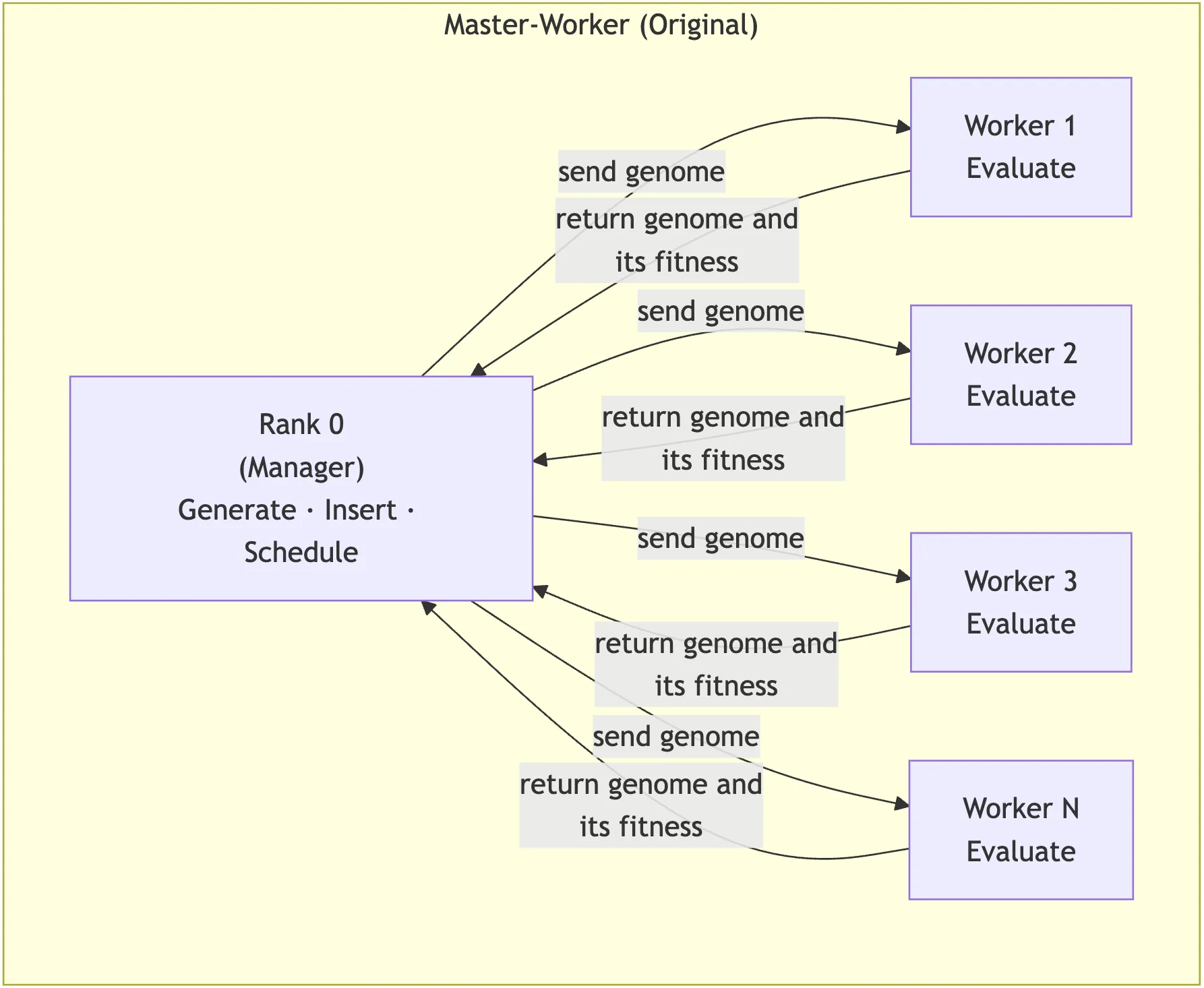
EXAMM is a neuroevolutionary framework for training recurrent neural networks on distributed hardware. Its original design used a centralized manager-worker architecture — one node controlled everything: genome generation, parent selection, crossover, and global state. That single node was both the system’s throughput bottleneck and its greatest point of failure. A crash meant losing potentially weeks of compute time with no recovery path.
What We Built
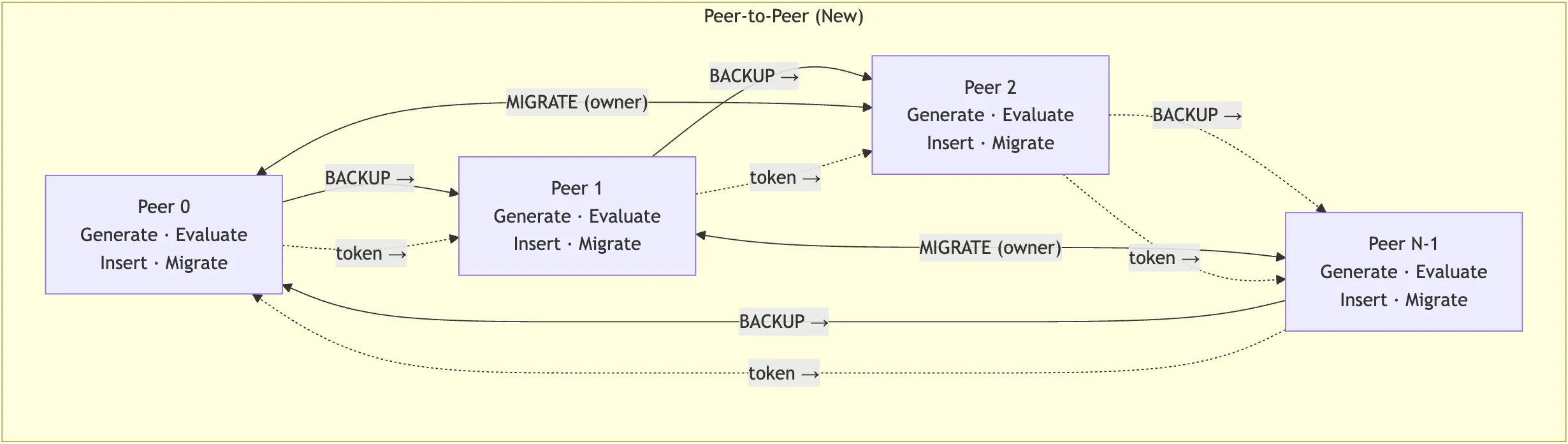
We redesigned EXAMM from scratch as an asynchronous peer-to-peer ring where every node is equal. No manager. Each peer independently runs its own evolutionary islands, shares high-fitness genomes with neighbors, and handles its own failure detection and recovery.
Key mechanisms:
- Deterministic structural hashing — every peer independently agrees on genome ownership without any central coordination, preventing redundant evaluations across the network
- Dual-mode genome replication — MIGRATE routes genomes to their canonical owner by structural hash; BACKUP propagates them around the ring as a geographic failsafe
- Snapshot-based fault recovery — each peer continuously maintains a rolling checkpoint of its neighbor’s island state; when a peer crashes and rejoins, it restores with state at most 10 seconds stale instead of rebuilding from a single genome
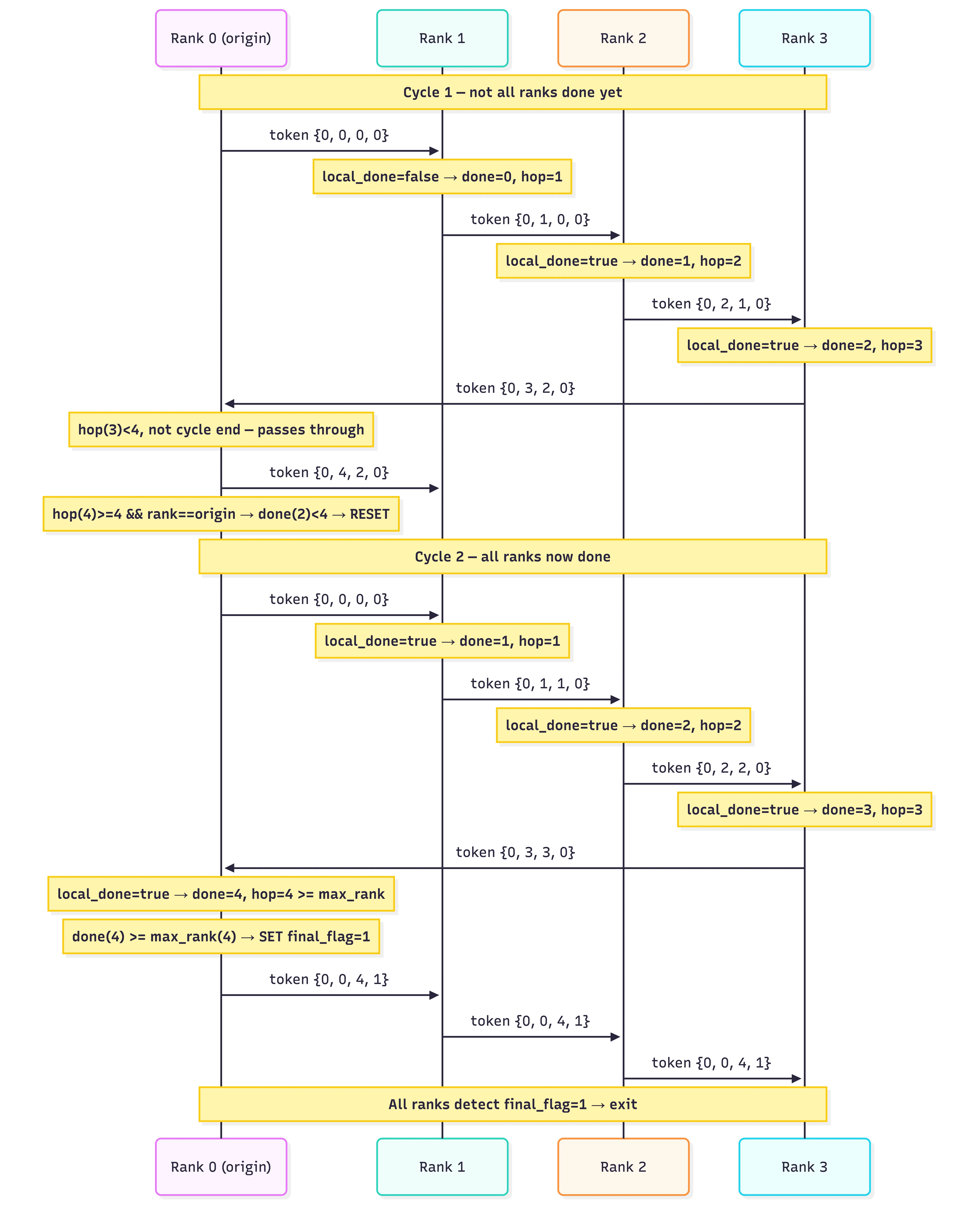
- Token-ring termination consensus — a circulating token accumulates per-peer completion flags; the system shuts down only when every peer independently agrees it’s done
Results
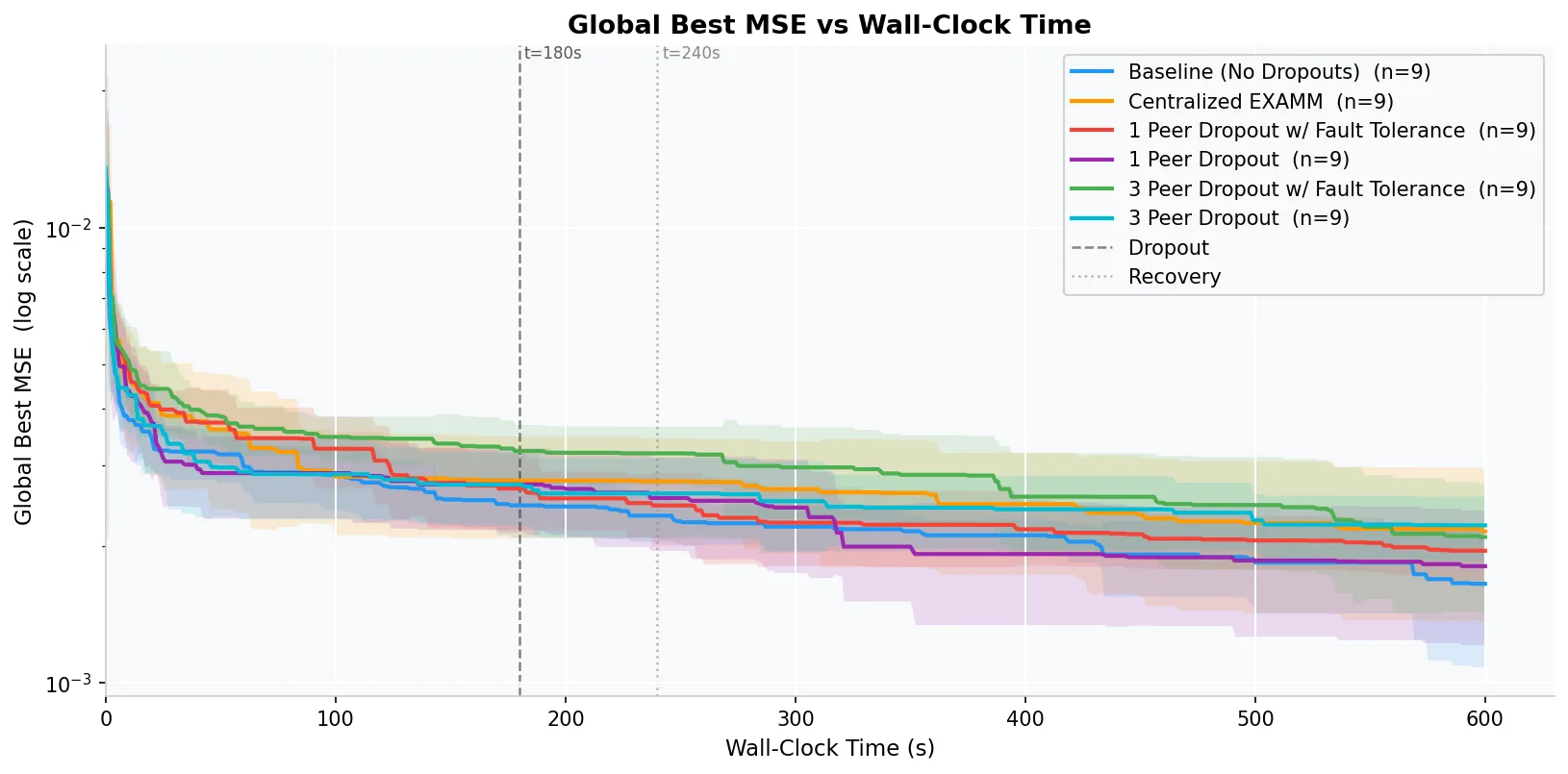
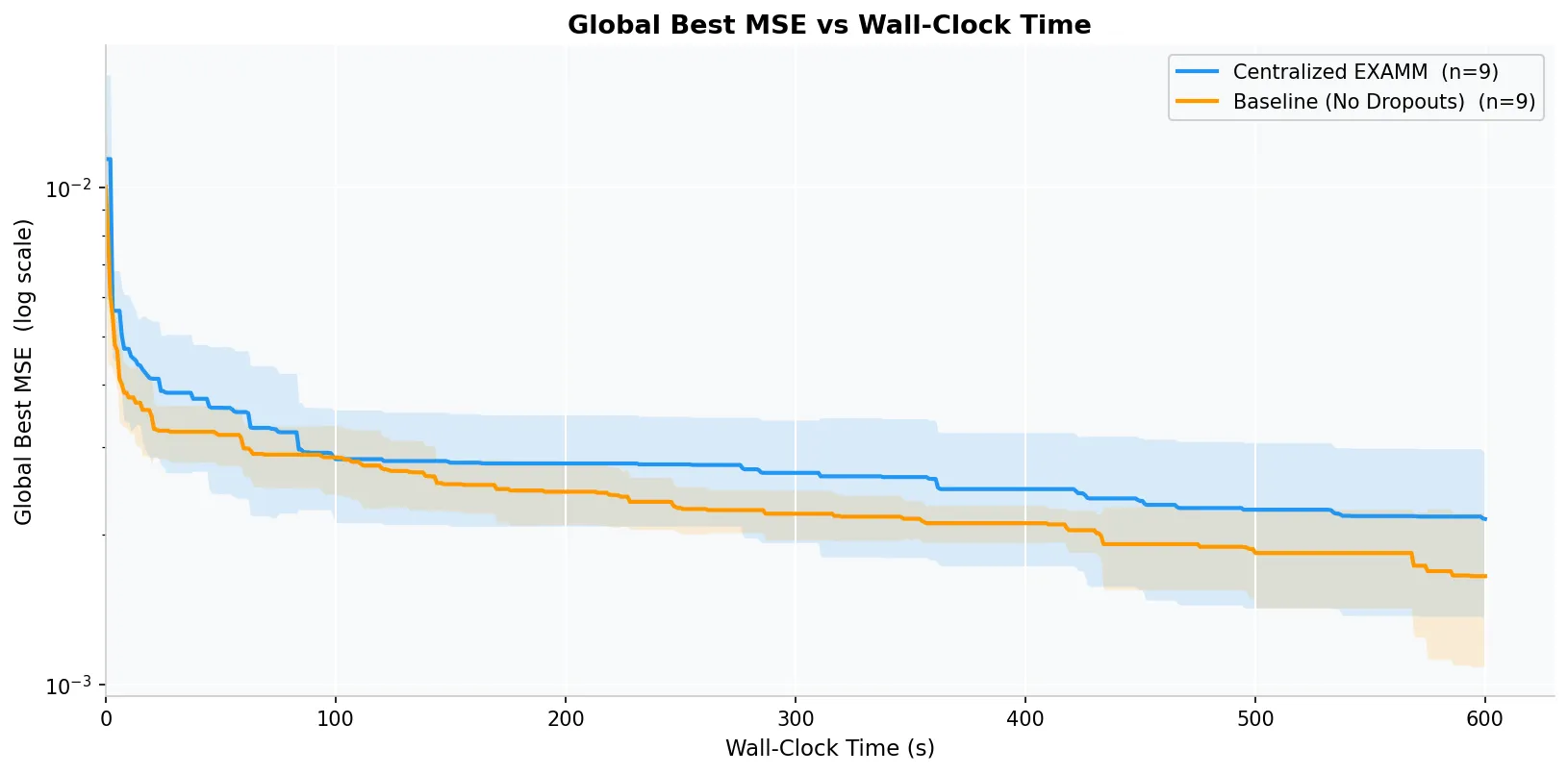
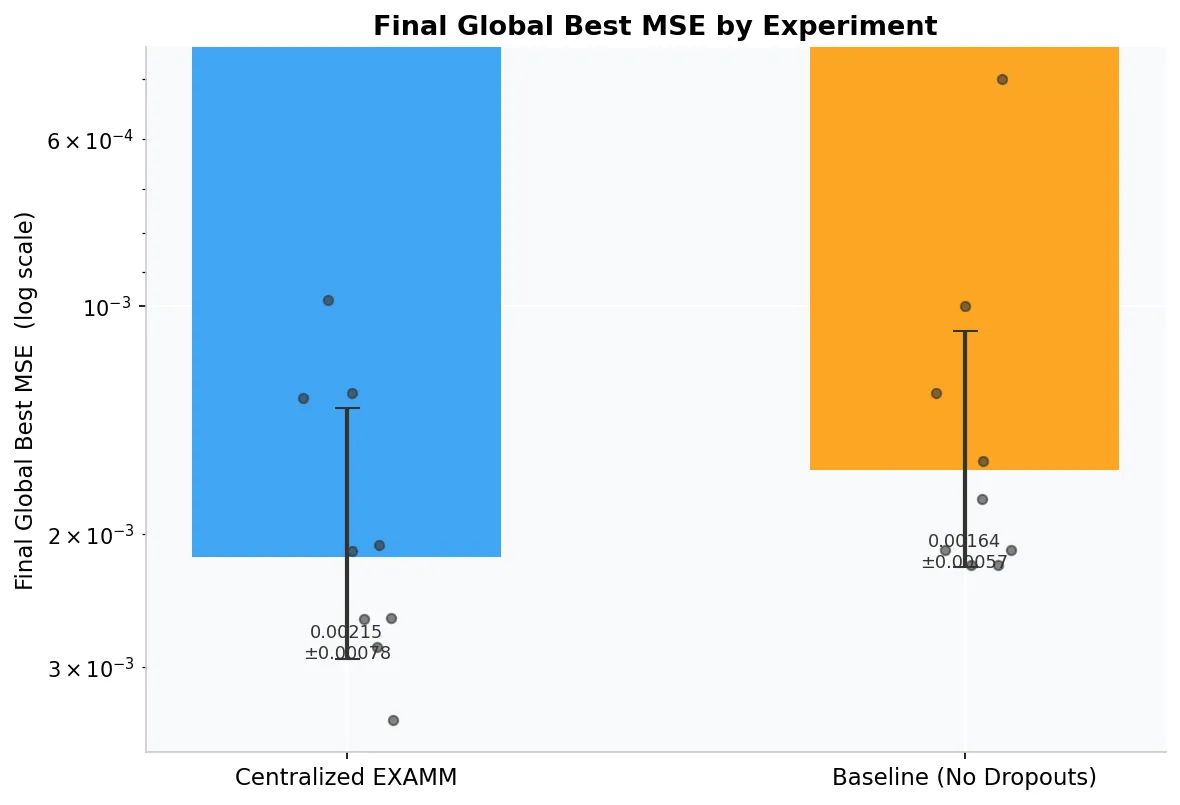
Evaluated across 54 independent trials on the NGAFID C172 aviation time-series dataset (predicting pitch angle from 32 flight sensor parameters):
| Condition | Final MSE | vs. Centralized |
|---|---|---|
| Centralized EXAMM (baseline) | 2.15 × 10⁻³ | — |
| P2P EXAMM (fault-free) | 1.64 × 10⁻³ | −23% |
| 1-peer dropout, improved FT | 1.93 × 10⁻³ | −10% |
| 3-peer dropout, improved FT | 2.06 × 10⁻³ | −4% |
The fault-free P2P system also achieved 2.5× higher genome throughput than the centralized baseline. With snapshot recovery, the system still outperformed centralized EXAMM after losing 75% of the cluster for over a minute — recovering peers rejoined with full island populations and immediately resumed high-fitness search.